All Articles

Missing Pages
A major occurrence in history can be spun in different ways, depending on the words used to describe it. The attacks of September 11, 2001 are a seminal event in the lives of students today, and are bound to remain so for future generations. Despite the indelible images of that day, the greatest impact that 9/11 will have in the public memory may be its description in the pages of history textbooks.
How (Not) to Conclude the Debate on the Armenian Genocide
You hear the story every year around this time: Turks massacred hundreds of thousands of Armenians in the early 1900s. The modern state of Turkey claims that the crumbling Ottoman state did not premeditate or direct the killings, noting that the Turks suffered as many deaths as the Armenians. Armenians, for their part, want the episode recognized as genocide, and they blame the international community for its inattention and hypocrisy. It sounds like one of those debates that will go on for eternity.
Chiquita Massacre
This passage from Gabriel Garcia Marquez’s One Hundred Years of Solitude could be read as another example of the Nobel Prize-winner’s genius ability to use fantasy as a metaphor for everyday life. It could be an imagined story that references the violent history of Colombia and the country’s seeming inability to learn from its experiences. Yet as those who visit Colombia will realize, Marquez describes Colombian reality much more often than one would think, and this case is no exception: in Colombia, banana companies help pile people like bananas.
Empowe(Red)
“I don’t drink Starbucks.” That used to be my mantra. They had destroyed Spinelli’s and were squeezing Martha’s, and I did not appreciate it. It wasn’t that I did not love their orange-mocha frappuccinos (I did), but I felt like buying their coffee would be an unforgivable breach of my ethical codes.
The Neuer Affair
In the past few weeks, Hillel Neuer, the executive director of the watchdog organization UNWatch, has become the persona non grata at the recently overhauled UN Human Rights Council in Geneva. At the Council’s fourth session in late March, Neuer delivered a speech that so infuriated Council President Luis Alfonso de Alba that it was stricken from the official UN record. What could Neuer have said to provoke such censure?
Fake ID
During a speech in Milwaukee in mid-April, Barack Obama brought his talk back to a common campaign theme: “Our incapacity to recognize ourselves in each other.” That was an especially poignant point to make in front of the mostly black audience. Obama’s authenticity as a black man has been questioned publicly by a number of people.
Truth in Advertising
Everybody knows that politicians lie. They mudsling, twist facts, and express regret over things, often claiming that what they “actually meant at the time” was misconstrued. In fact, it is so obvious that the noses of our current leaders are unnaturally long that it is not even cool to talk about it anymore. Bush is a liar, Cheney’s a bigger liar, and Rove’s the biggest, fattest liar of all. Everyone knows it. Everyone accepts it. No one seems to care.
Left on Main Street
I was heading out the door after making a speech in Defiance, Ohio — a quaint, charming town deep in thestate’s northwest corner — when a middle-aged man in faded jeans and a hunting jacket stopped me and extended his hand. “Excuse me, Ms. Brown,” he said. “I just wanted to let you know that I’m a registered Republican.” Given that my father, Sherrod Brown, is a longtime Ohio politician and a longer-time Democrat, such an introduction usually does not bode well.
Corrupting China
Media and academic circles focus on China’s increasing economic and political power almost on a daily basis. Highlighted on the New York Times website is a section entitled “China Rises,” and major magazines declare that “nothing is changing the world’s political and economic landscape more than China’s joining the ranks of the great powers.” Such talk appears everywhere.
Nuclear Patriotism
It is easy to write off Iranian President Mahmoud Ahmadinejad as a leader lacking in diplomatic skills and refinement, or, in less elegant prose, as a lunatic.

Generation Blowhard
Rhetorically speaking, the pundit is a strange animal: a kind of crippled orphan using the language of a priest, a self-righteous uncle and a used car salesman combined.
Digital Neocolonialism or Benevolent Hegemony?
The Internet’s capacity for making information seamlessly accessible is even more impressive given its largely unregulated and decentralized nature. This freedom from regulation has allowed superior technologies like Google to quickly make themselves the standard. Yet although the protocols and codes for the Internet belong to the private sector, important components of the Internet rest within the grasp of a single power: the United States government.
The Nuclear Option
The nuclear industry, despite a rough patch in the past few decades, may be poised for a major renaissance. As the prices of conventional fuels such as coal and natural gas skyrocket, nuclear power has become increasingly attractive to utilities looking for stable operating costs, environmentally friendly sources of energy, and insurance against geopolitical threats to energy security. Finally, in an era of rising concern over energy security, the nuclear industry is being promoted as a domestic solution to the nation’s demand for imported energy.
The New Spy in Town
Americans across the political spectrum have attacked George W. Bush’s administration for creating a double standard with respect to sensitive information getting leaked to the press.
Reaching for the Stars
The responsibility for choosing the proper judicial body reverts back to the UN. Unfortunately, as the oil-for-food scandal has shown, it is no longer clear that the international community can afford to place its trust in the UN.
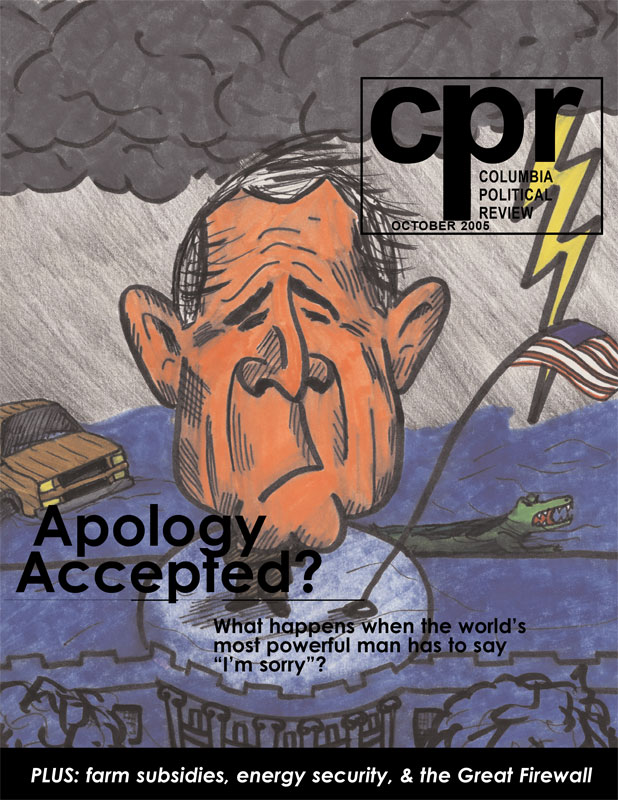
Apology Accepted?
On September 13, to the astonishment of both the public and political pundits, George W. Bush said he was sorry.
The Rise of Harry Reid
The boldness of the recently chosen leading Senate Democrat was surprising given his moderate record, but appropriate given the current political climate. Reid normally exhibits outspoken moderation, which is emblematic of the larger uncertainty within the Democratic Party as a whole.
Africa's New Union
“Extreme poverty can be ended, not in the time of our grandchildren, but our time,” wrote Jeffrey Sachs, director of Columbia’s Earth Institute and Special Adviser to Kofi Annan on the Millennium Development Goals, in his new book, The End of Poverty.